Wednesday’s weak close left one question hanging: would sellers press their advantage, or was the slide already exhausted? Thursday answered it with an opening drive higher that sellers never contested until a late stall near 23,056.
EXECUTIVE SUMMARY
- The bigger picture is still bearish (two straight weeks of lower value, longer averages negative), so today reads as a counter-trend recovery, not a regime change.
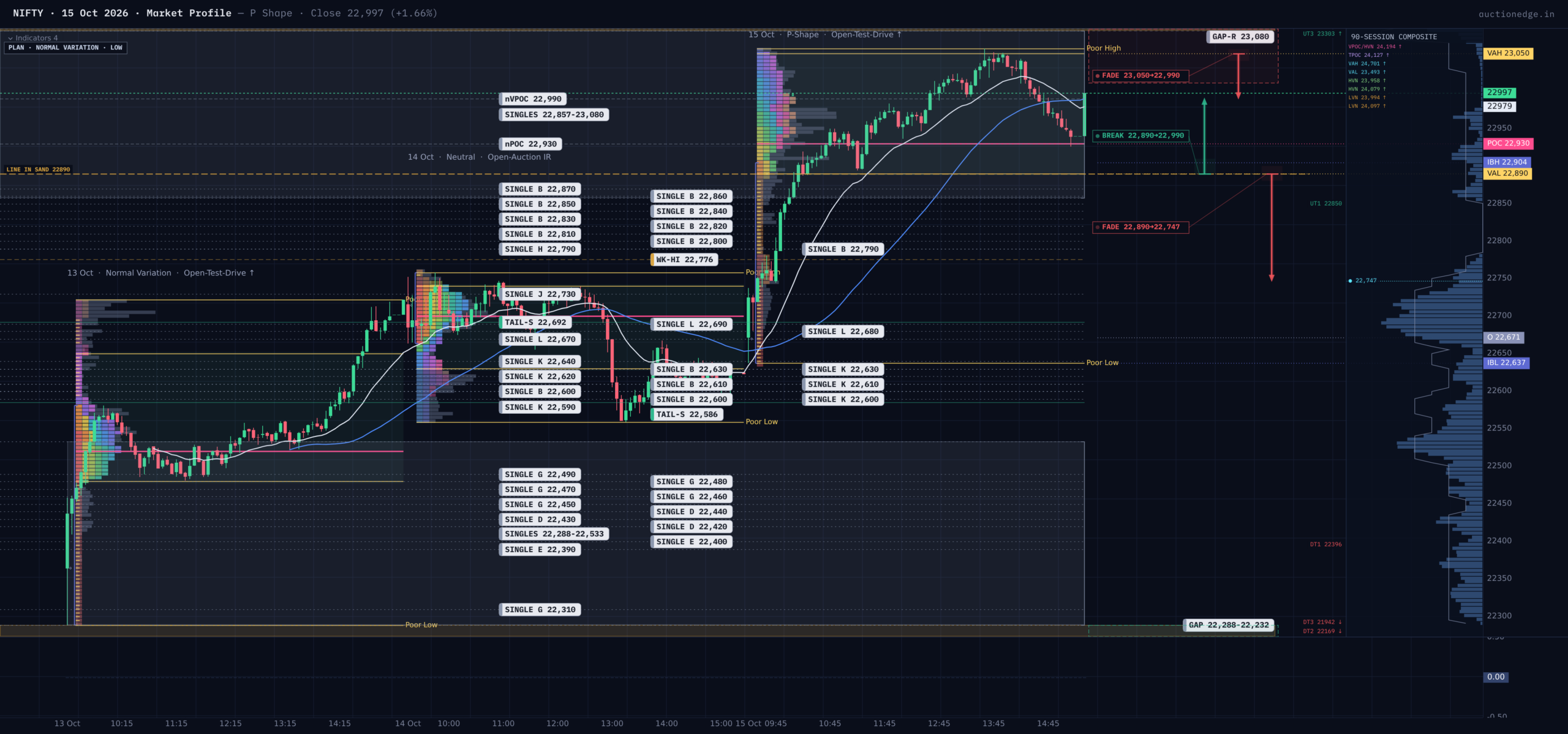
- Today was a P-shape day (a short-covering rally with most trade bunched near the highs): a gap up, an immediate drive, and a close at 22,997 near the high.
- Tomorrow’s primary scenario is rotation around today’s value zone; the line in the sand is 22,890, the bottom of that zone.
MACRO CONTEXT
Value has migrated lower for two consecutive weeks, and our composite market read still leans bearish with the 50-day average under the 200-day (a death cross). Daily value had risen three sessions running into Wednesday, so this bounce has been building inside a falling weekly structure rather than reversing it. Price now sits in the lower half of the 834-day macro range, below its volume midpoint near 24,220. Today’s strength therefore faces a real question: is it new buying or only shorts covering?
Who Controlled the Day
The open was an open-test-drive (price probes once, then runs one way without returning). Buyers gapped the market up 49 points, held the first-30-minute low, and broke out of the Initial Balance (the first hour’s range) in the very next half-hour, so conviction showed up early. That balance spanned 267 points, nearly three times Wednesday’s 94, which tells you this was initiative buying (participants chasing price higher), not responsive dip-buying.
Value then moved, not just price. Today’s value area (the zone holding about 70% of the day’s trade) sits at 22,890–23,050, fully above Wednesday’s 22,630–22,740 with no overlap. That is the migration: time and volume both accepted higher prices, with the busiest volume at 22,990 and the busiest time at 22,930. Volume leading time by 60 points, and the close above both, says late activity was acceptance, not trapped longs. The footprints: a buying tail (prices sellers could not hold, quickly rejected) from 22,637 to 22,747 at the base of the morning, and a thin overhead rejection zone at 23,011–23,056 where the afternoon stalled. The range of 419 points ran well over the 20-day average range of 247 and about 1.55 times the typical daily swing of 270, a 1.65-sigma day, so expansion was real, not noise.
Volatility Cross-Check
Intraday swings are running about 42% larger than options imply, and realized volatility (18.2) sits well above implied (11.8), so options are cheap relative to what the market is doing; expect tomorrow’s moves to be larger than they look.
Anchored VWAP Structure
Today’s session VWAP (22,940) sits above yesterday’s (22,698) and the day before’s (22,681), a rising stack that favors the buyers. The week-to-date VWAP at 22,735 is the intermediate pivot underneath; the averages are not compressed, so no coiled breakout signal. The slower multi-month VWAP stack is mixed and adds nothing.
Balance and Structural Zones
Price closed 1% above the 12-day balance whose top is 23,080; that edge, and not the lower balances, is what matters tomorrow. Above are three layered supply areas: the fresh rejection zone at 23,011–23,056, an older partly filled tail at 23,056–23,080 and 23,080–23,163, plus an untested volume midpoint (a naked POC, a prior day’s high-volume price never revisited) at 23,090 and an unfilled downward gap at 23,222–23,350. Below, today’s POCs at 22,990 and 22,930 are magnets, then the buying tails at 22,637–22,747 and 22,559–22,613.
What History Says
The statistical picture is a slight lean, not an edge. After closes in the top quarter of the day’s range the next day finished higher 52% of the time (n=530), but the two samples closest to today’s exact setup lean the other way: after this open-and-shape combination the next day fell 55% of the time (n=22). With every edge below 1.0, I read this as “no decisive historical edge.”
Opening Playbook
- Inside value (22,890–23,050): balanced rotation; fade the edges, buying near 22,890 toward 22,990.
- Below value, inside range (22,637–22,890): needs to reclaim 22,890 quickly; failure to do so exposes the thin stretch down to the 22,747 tail.
- Above value, inside range (23,050–23,056): a six-point sliver; any test is a test of the overhead tail.
- Below the day’s low (under 22,637): the entire advance is erased; look toward 22,559–22,613.
- Above the day’s high (over 23,056): TRAP WARNING. A gap up runs straight into layered supply at 23,056–23,163 and the 23,090 naked POC; fade it unless 23,080 holds as a base.
GAME PLAN / BOTTOM LINE
Tomorrow’s primary expectation (about 45%) is rotation inside or just around the new value zone, with 22,990 as the pivot. The alternative (about 30%) is a pullback through 22,890 as the weekly bearish structure reasserts itself, and the lesser case (about 25%) is acceptance above 23,080 that opens the road toward the older 23,200s. Dealers appear short gamma, which can amplify moves either way, so size accordingly.
LINE IN THE SAND: 22,890. Above it, today’s value is intact and the bias is constructive; below it, the short-covering rally is being unwound and the bias turns defensive.
KEY LEVELS (ordered high to low):
– 23,222–23,350 | Unfilled gap | Overhead supply from the prior breakdown
– 23,090 | Naked POC | Untested for 20 sessions; sits inside the older tail
– 23,050 | VAH | Top of today’s value; capped by the fresh rejection tail
– 22,990 | Volume POC | Where the day’s heaviest volume traded
– 22,940 | Session VWAP | Fair value of the day’s auction
– 22,930 | TPO POC | Where the day spent the most time
– 22,890 | VAL | Line in the sand
– 22,747 | Top of buying tail | First reference on a failed hold
– 22,637 | Day low | Base of the tail; a break erases the day
Session Learning Note
An opening drive that clears the first hour of trading is only as good as the acceptance behind it: the market earned it by letting volume and time both migrate higher, but it still has to prove it can hold new value against an overhead stack of unsold supply.