Methodology

Updated · 2026-05-01

How Auction Edge reads the market.

This page exists for one reason: to show, honestly, what we do. We are not selling a black box. If you want to evaluate whether our framework matches how you think about index trading, you should be able to read this page and decide.

1. The framework — auction theory

The market is an auction. Price moves up to find sellers, down to find buyers, and most of the time, sideways to confirm that value has been agreed. Jim Dalton's work — most clearly in Mind Over Markets and Markets in Profile — turns this observation into a working vocabulary: value area, point of control (POC), initial balance (IB), single prints, naked POCs, balance, initiative versus responsive activity, and other-timeframe (OTF) participation.

We chose this framework because it answers the questions an index trader actually has:

  • Where is value? Is it migrating?
  • Who is in control — initiative buyers, initiative sellers, or responsive participants on both sides?
  • What structural levels matter today, and which can be ignored?
  • Is the auction trending or balancing?
  • How does the current state compare to the population of similar states in the historical record?

Indicators answer none of these. Auction theory answers all of them. That is why we built around it.

<<<INPUT_NEEDED_BLOCK>>>confirm whether to cite Dalton's books by title in the public-facing copy<<<END>>>

2. The data

You can only describe an auction if you have the auction data. Ours, in detail:

  • NIFTY 1-minute price historyconfirm exact bar count, date range, and whether NIFTY-I / spot / both. We currently say "5+ years."
  • 100K+ historical rotations — derived from a fractal rotation engine that segments the price stream into directional moves and balances
  • Options-chain history — IV smile snapshots, GEX, intraday flow. how far back, which instruments
  • Tick data via ClickHouse — high-resolution storage for the high-frequency engines and back-testing. live-streamed or end-of-day reconstructed?

We are deliberate about scope. Currently the focus is NIFTY 50 (and the front-month NIFTY future, where applicable). Bank Nifty, Sensex, and single-stock work are on the roadmap — not yet shipped, not pretended.

3. The engines

These are the production engines that power the dashboard:

Engine · 3.1

Fractal rotation engine

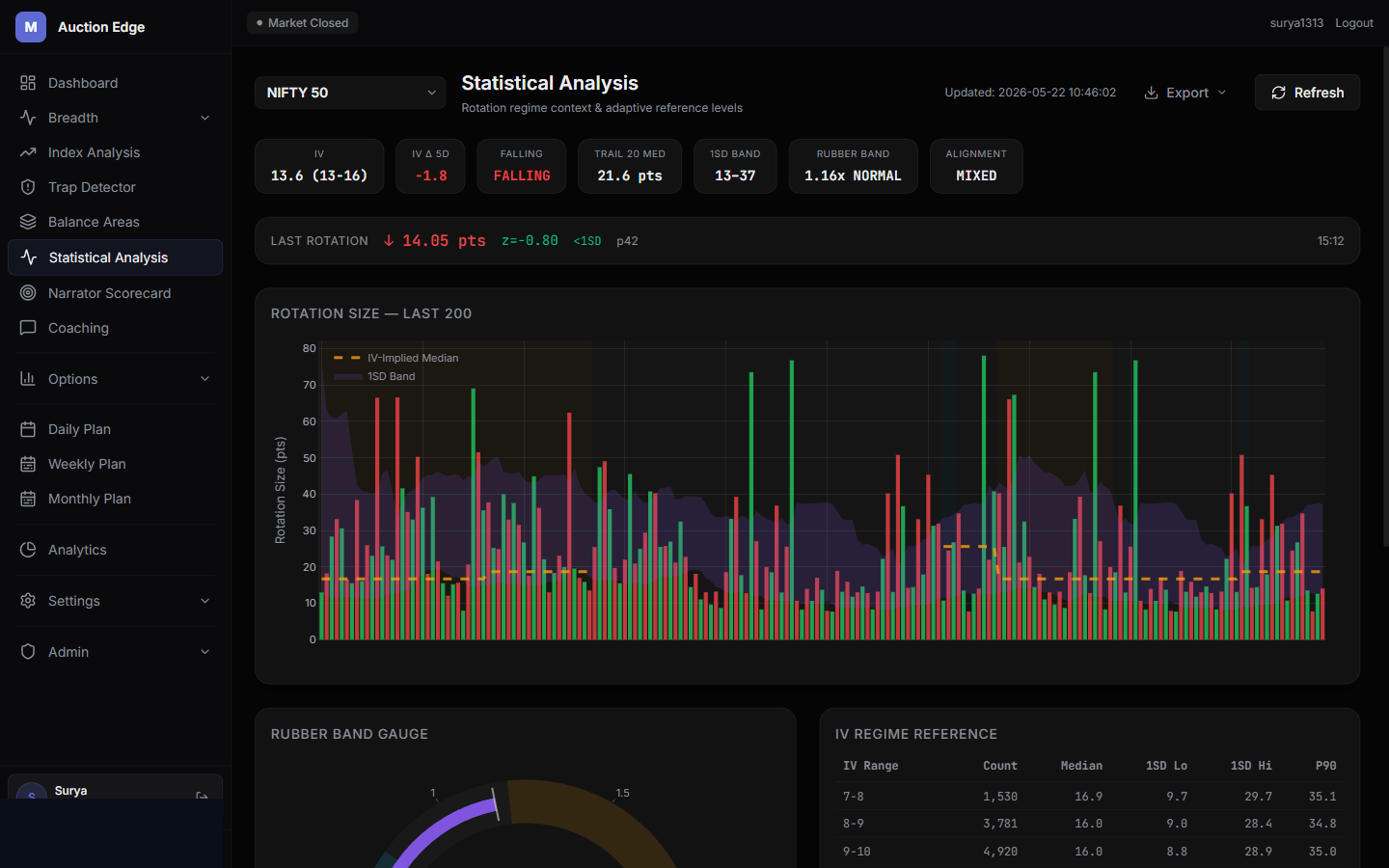
Segments the price stream into rotations — directional legs separated by reversals. Builds the 100K+ rotation library that downstream statistics draw from. Used to compute distribution of rotation sizes, durations, and follow-through, conditioned on regime.
Engine · 3.2

Regime engine

Classifies the current state across volatility regime, IV / HV spread, rubber-band state, and z-scores against trailing standard-deviation bands. Writes a JSON state file every refresh cycle and emits a daily enriched CSV. The substrate the Narrator reads from.

Engine · 3.3

Structural-levels engine

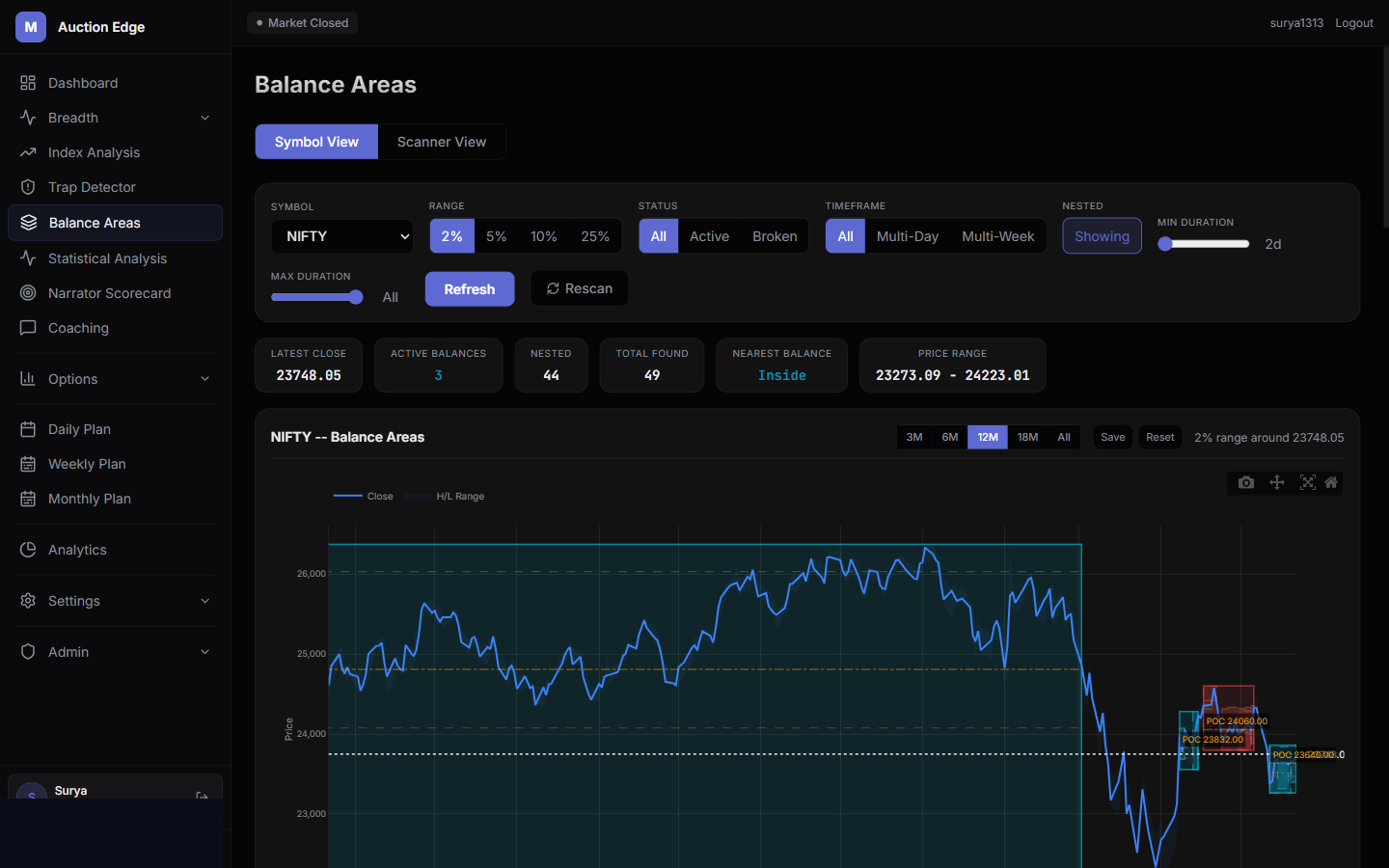
Detects and tracks single prints (with active/inactive status across sessions), naked POCs (with creation date and distance metadata), balance areas, poor highs/lows, and RTH gaps. All auto-tracked from active to tested to resolved.

Engine · 3.4

Profile builder

Builds intraday and composite profiles in real time. Computes value area, POC, IB, range extension, and structural shape (B, P, b, p, double-distribution, neutral, etc.). Fast enough to recompute on every refresh without stalling the UI.

Engine · 3.5

Options analytics

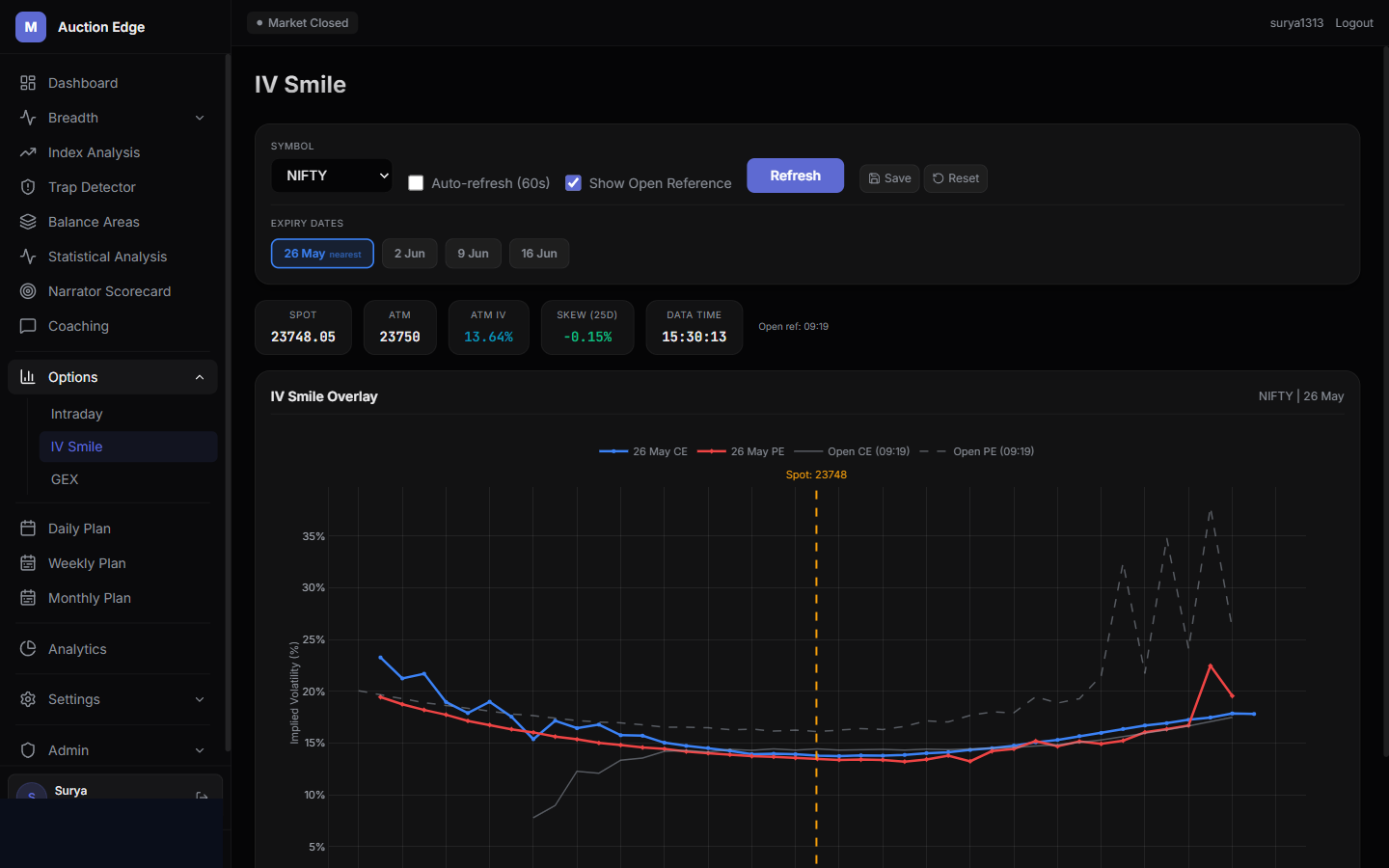
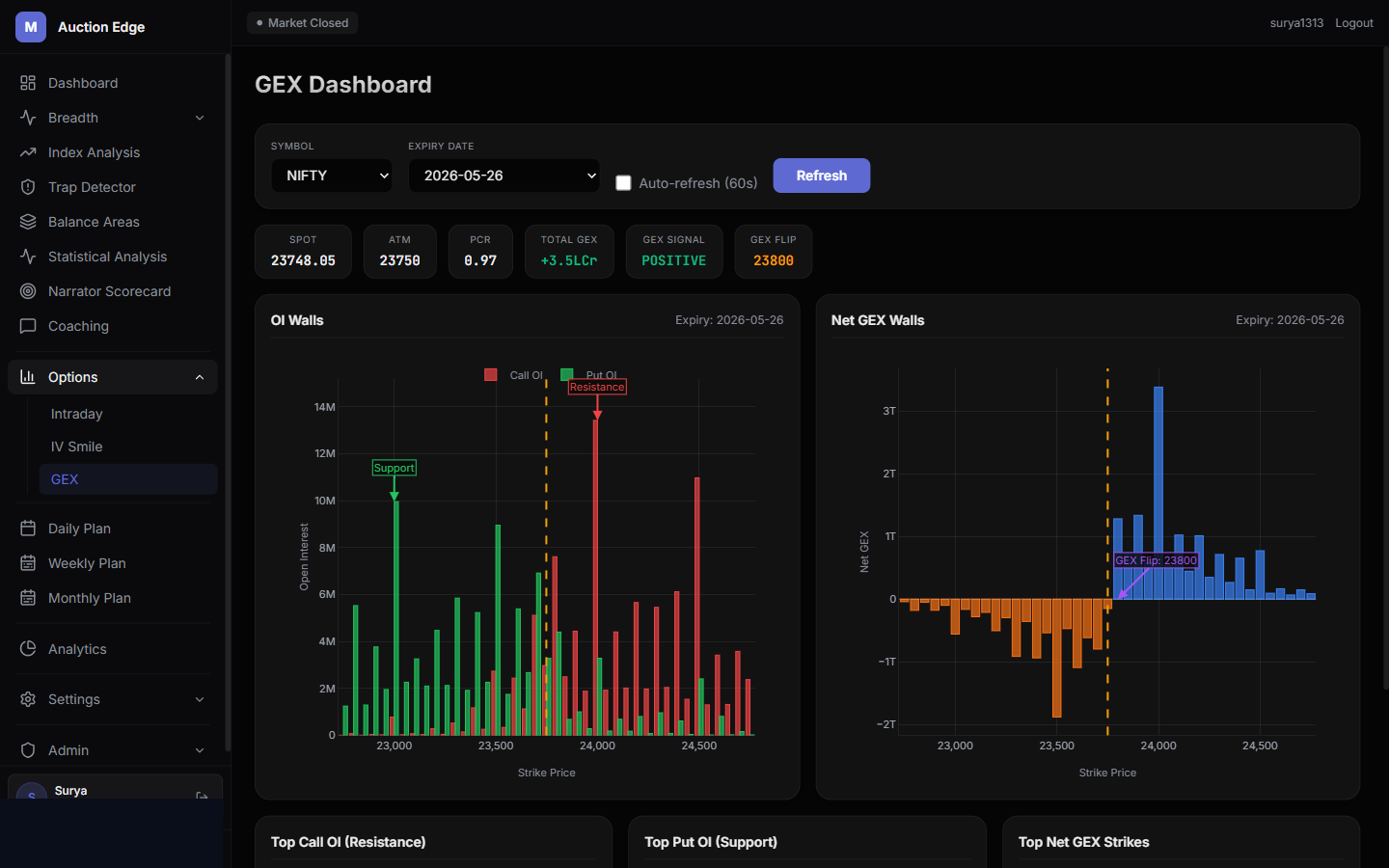
GEX (gamma exposure), intraday options flow, IV smile snapshots, and dealer-positioning inferences — derived from the options-chain data and refreshed on the cadence the chain itself updates.

Engine · 3.6

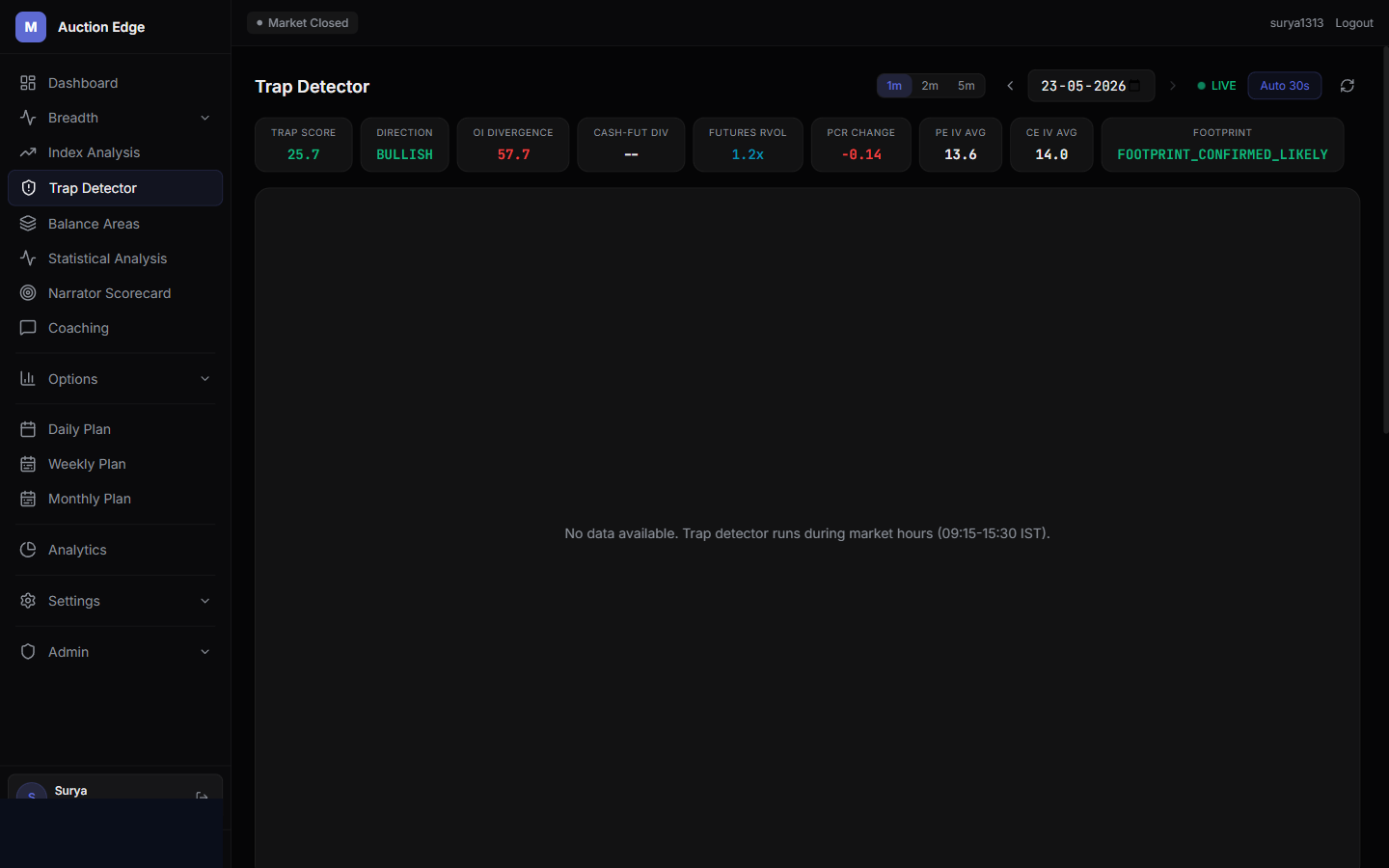
Trap detector and scorecard

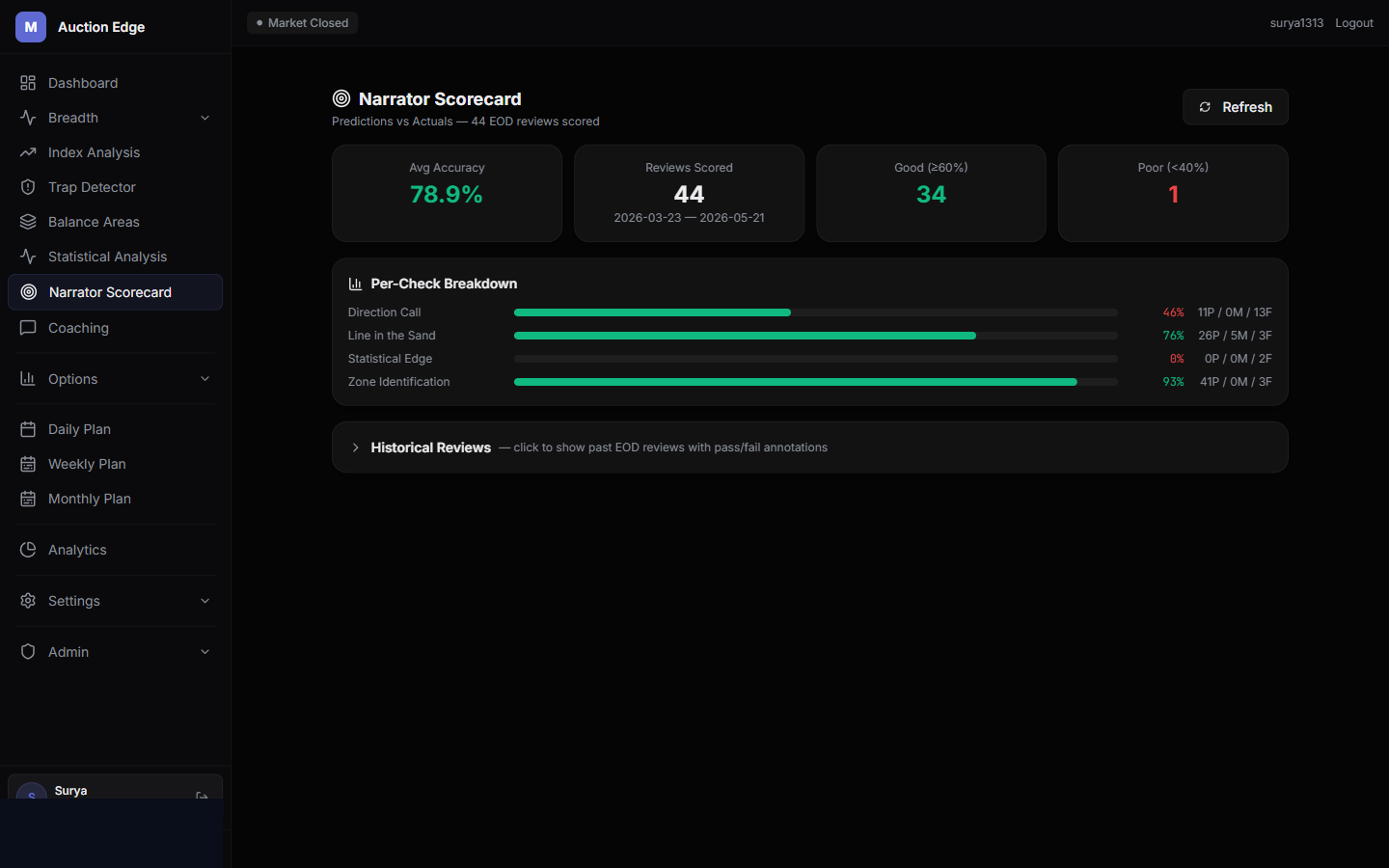
Trap detector flags conditions historically associated with failed breakouts and false continuations. Scorecard (V2 design in progress) grades each of the five structural zones for the next session.

4. The Narrator

The Narrator is an AI market analyst, currently powered by Anthropic's Claude. It runs after every session boundary — Post-IB, Lunch, EOD, and the Weekly Plan — and produces:

  • A structured brief in the dashboard
  • A long-form post on the headless WordPress blog at /blog
  • A version cross-published to Substack

The Narrator reads from the regime state JSON, the structural-levels store, the options state, and the rotation library. It does not free-form a market view; it composes a brief from quantitative state. The output is the kind of brief a senior trader would write if they had time to write one every day — observational, structural, and committed to a "line in the sand" rather than a hedged non-answer.

The Narrator is not a signal generator. It does not say "buy" or "sell." It describes what the auction has done, what the structural setup is, and what the scenarios look like.

5. The Coach (preview)

The forthcoming AI Trading Coach uses the same engines the Narrator uses, but applied retrospectively to your trades. It reconstructs the market state at the timestamp of every entry and exit, cross-references the Narrator's contemporaneous read, and rates the trade on multiple structural axes.

Full details: /coach.

6. Why this is hard

We will not pretend the engineering is trivial. A few of the harder problems we have solved:

  • Real-time profile recalculation at sub-second latency, including value area / POC, on a moving 1-minute stream — without UI stutter
  • Regime classification with stable boundaries — naive bucketing flickers; we use trailing SD bands with hysteresis to avoid regime "flashing" between two adjacent buckets on a single tick
  • Cache invalidation on settings change — time-based caches (e.g. 60s for daily OHLC) had to be reset at the top of recalc loops, otherwise lookback changes silently failed. We learned this the hard way.
  • Single-print tracking across sessions — naive detection re-fires previously tested zones; persistence requires session-aware status tracking with intraday updates
  • Narrator factuality — keeping AI commentary grounded in the underlying state JSON, with a structured prompt that surfaces all relevant numbers explicitly so Claude does not need to "remember" them
  • Cross-engine consistency — the regime label, the structural levels, and the options state must all reflect the same moment in time. We use a single refresh tick that fans out to every engine, then a write barrier before the Narrator reads.

None of this is novel computer science. It is just careful engineering applied to a domain where shortcuts produce confidently wrong output, and confidently wrong output is worse than no output at all.

7. What this is not

  • Not a back-tested strategy generator. We do not publish "this signal returned X% over Y years" because we do not run the engines as signal-emitters.
  • Not high-frequency. The Platform's analytical cadence is intraday-to-daily, not millisecond.
  • Not a substitute for thinking. The dashboard is a higher-resolution lens. You still have to make the call.