The question into Thursday was whether Wednesday’s tight, two-sided trade would resolve with buyers taking over — and by the close, buyers had answered decisively, though the afternoon’s late stall near the highs keeps the follow-through question open.
EXECUTIVE SUMMARY
- The bigger picture is still a market below its long-term averages with a mildly bearish composite read, even as value has stepped higher three sessions running.
- Thursday was a one-way Trend Up day (a day where buyers control from open to close), closing at the very top of its range after an open that never looked back.
- Tomorrow’s line in the sand is 22,930: accepted above it, buyers stay in charge toward the 23,000 area; back below it, today’s move becomes a stretch that gets pulled toward 22,840.
MACRO CONTEXT
The weekly picture is mixed. Last week closed lower and the market sits in the lower half of its multi-year balance zone, with the 50-day average under the 200-day (a “death cross”), so the broad backdrop leans defensive. Against that, the daily value area (the zone holding roughly 70% of the day’s trade) has migrated higher three sessions in a row, and today’s advance was with that short-term flow but against the larger downtrend. Moving averages and the longer VWAP stack are tangled rather than aligned, which argues for treating rallies as tradeable but unproven.
Who Controlled the Day
Nifty opened at 22,691 on an Open-Test-Drive (an open that probes one side briefly, then drives the other way), tested lower for a few minutes, then ran. That is initiative activity: buyers who weren’t anchored to Wednesday’s value acting proactively. They defended nothing and simply kept paying up. The first hour’s range (the Initial Balance) was wide at 142 points, and it broke upward early, which is the signature of conviction rather than hesitation. The market ended at 22,937, about 92% of the way up a 305-point range — a strong close that tells us sellers never mounted a meaningful counter-attack.
The day opened about 8 points below Wednesday’s close, inside Wednesday’s range, yet value moved decisively higher and did not overlap. Today’s fair-price zone sits at 22,780 to 22,930, entirely above Wednesday’s 22,570 to 22,720. The acceptance was real: the heaviest time was spent near 22,840, and the afternoon’s last pushes left a trail of thin, single-print areas (prices touched once and left) at 22,915 and 22,880 that mark where the afternoon advance moved fastest.
The footprints say who acted. Morning trade carved a buying tail (prices sellers couldn’t hold, rejected fast) from 22,657 to 22,741: responsive buyers defending the low. Everything after was one-timeframe buying (participants with longer horizons pushing in one direction), without a selling tail at the top. That cuts both ways: no rejection yet, but also no excess, so the high looks unfinished rather than exhausted.
One divergence deserves attention. Time spent clustered near 22,840, while the heaviest volume printed far higher, around 23,040 — a 200-point gap between the two. The market was most active well above where it spent its time, yet it closed below that volume cluster. Late buyers may have paid up and now hold inventory with little cushion beneath them.
Anchored VWAPs
Today’s average price was 22,941, essentially where the market closed. Yesterday’s was 22,702, and the week-to-date VWAP, a key middle reference, sits at 22,743. The order is mixed rather than cleanly stacked, so this reads as a transition higher, not an established trend, and the band is not compressed. If the market pulls back, 22,743 is the level buyers must defend to keep the structure constructive.
Volatility
Options are priced above recent realized movement, yet intraday swings have run well larger than option-implied size, so expect wide, quick rotations rather than a quiet tape.
Where Tomorrow’s Trade Lives
The market is still inside a nine-day balance spanning 22,372 to 23,121; today’s close lies in its upper quarter, with the 23,016 to 23,121 selling tail from October 21 forming that ceiling, the first major overhead barrier. A gap up into that zone is the classic trap setup. Underneath, today’s buying tail near 22,700 and the thin prints near 22,880 are the reference levels that matter most, with the 22,840 point of control a magnet if price falls back.
Historical analogs are cautious. After a trend day with this kind of open, the next session closed lower more often than higher (roughly 58% to 33%, 24 cases), though the edge is slight, so treat it as a lean, not a signal. A narrower, normal-variation session of about 220 points is the most common outcome.
Game Plan / Bottom Line
Buyers won the day, but the close sits at the top of a congested area and just below the heaviest volume. The primary expectation is a more rotational Friday: an open near value is likely to be faded back toward 22,840, while acceptance above 22,962 opens the path to 23,016. A gap up into the old selling tail deserves skepticism; a gap below 22,657 would erase the whole day and suggest the advance was exhausted.
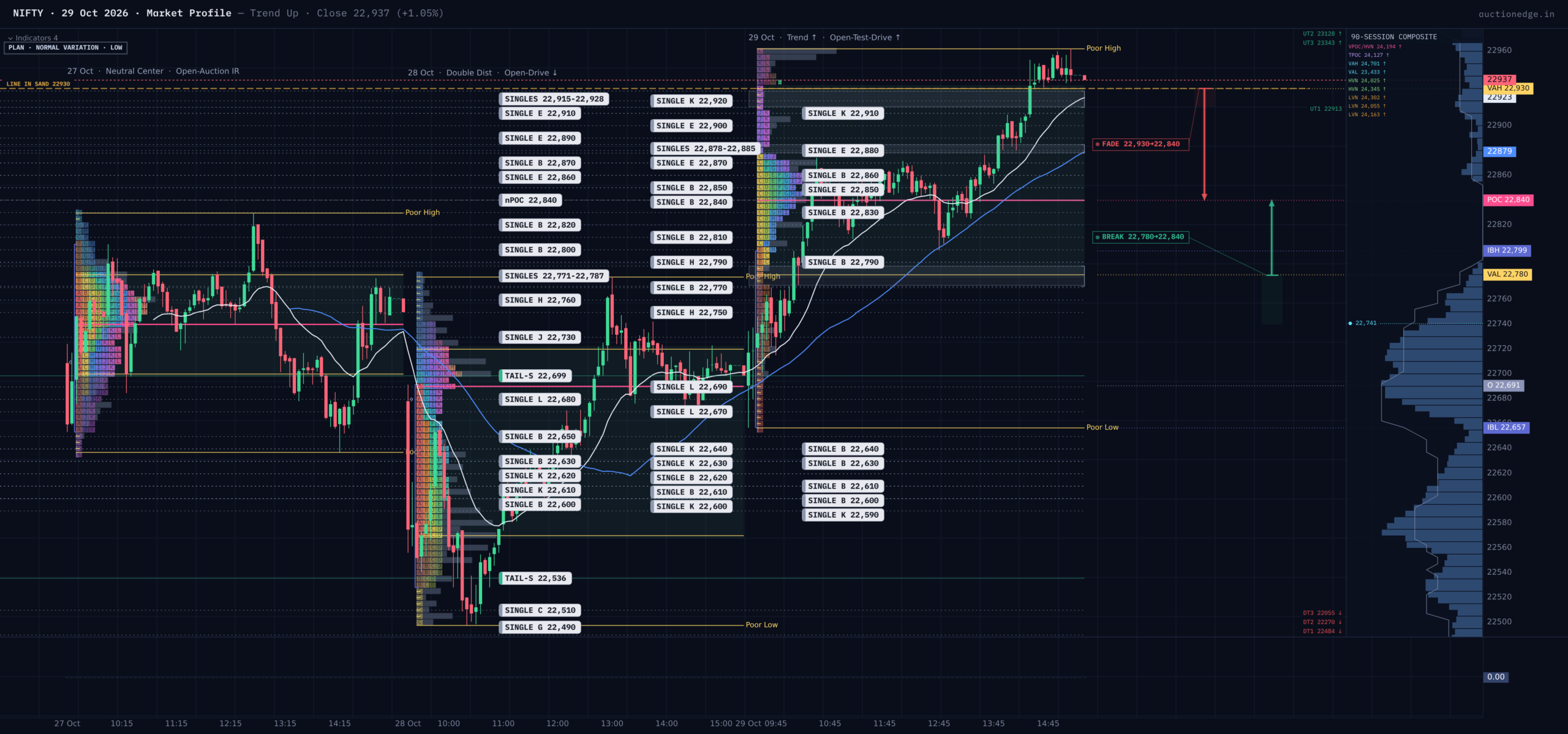
Line in the Sand & Key Levels
LINE IN THE SAND: 22,930. Above it, the bias is constructive; below it, the bias reverts to a return toward value.
– 23,016–23,121 | Selling tail | Prior rejection; first major overhead barrier
– 22,962 | Day high | Break confirms acceptance above value
– 22,930 | Value area high | Line in the sand
– 22,880 | Single prints | Fast-move area; first pullback reference
– 22,840 | Point of control | Magnet and balance of the day
– 22,780 | Value area low | Failure here voids the day’s value
– 22,743 | Week-to-date VWAP | Intermediate pivot
– 22,657 | Day low | Origin of the buying tail
Session Learning Note
When a market opens on a drive and value moves cleanly above the prior session, the trend is real — but a close at the extreme without excess means the next day tests whether new buyers will pay the same price. Strength that ends unrejected is information, not a guarantee.